Showing posts with label society. Show all posts

Why The Hill Of Crosses is Cooler Than It Sounds

Saturday, July 16, 2011


I'm spending the month of July in Klaipeda, Lithuania and I will be blogging the experience. Some posts will be intentional but a lot of it will be stream of consciousness. I chalk up any terrible culturally insensitive things I may say to jetlag. Enjoy the journey with me!!


Imagine that your entire life you feel the identity you've been given is wrong. You spend your days being educated under one system that drills you constantly on what your supposed to be. You learn one common language, you learn one common history, you're told that the world is supposed to look and act a specific way.

Imagine you had a nagging suspicion that this world wasn't right. No matter how often the authority figures around you assured you that this is the way things should be, YOU feel that its not right. Perhaps the more you try and push against the way your told this world should be the more resistance you get. Friends begin to reject you, teachers begin to eye you warily, people you trust whisper that if you don't stop thinking the way your thinking you might be shunned. That job your supposed to get might disappear. But you don't care, and you're desperate to find a way to express your rejection of this reality boldly and evocatively. Your tired of the suffocating existence this world forces you to accept.

You begin to hear rumors of a place...a place that passionately and clearly declares that this reality is
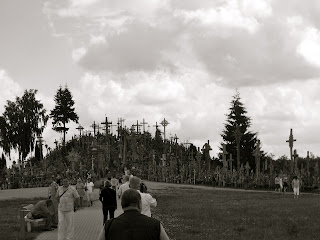
a sham. A place that claims this reality holds no exclusivity over anyone's existence. Wouldn't you want to find this place? Wouldn't you want to do something to participate in the revolutionary statement it made?

This scenario is the basic story of "The Hill of Crosses." No one really knows exactly how it was started. There's a few stories that go back to 1850. Originally it was believed that the son of a local merchant promised to plant a cross on a hill outside of Šiauliai. When the boy was healed, he obliged his promise.

Lithuania, through much of its history, has fought constantly for cultural relevance. First the Poles, and then the Russians worked hard to absorb Lithuania. While the Poles favored language dominance and reserving good land for Polish nobility, the Russians had a tendency to ship anybody who complained too loudly off to Siberia. Lithuanian culture was continually struggling for its own survival. After the failed Lithuanian insurrection against Russia in the 1860s more crosses began to appear.
The Hill of Crosses gained new relevance during the Soviet occupation. The Soviets deported the Lithuanian population in earnest. Schools were set up to erase the Lithuanian language and culture, and Russian transmigrants were flooded into the country in an effort to overwhelm the natives. In 1961 the Hill of Crosses was labeled an undesirable place by the communist party and bulldozed. Still...the crosses kept returning and it was bulldozed several times over the next 2 decades.


The Hill of Crosses is an incredible reminder that belief matters. To quote Rob Bell, "....some things are true, but some things are TRUE." There may be forces or circumstances that continually reinforce the idea that this reality is all you have, or that things, no matter how hopeless can never change. But this reality pales in comparison to the signs of reality just beneath the surface of life. The Hill of Crosses, in its proper context is a stark reminder and a peephole into that truth.

More pictures of the hill of crosses can be found here.


Life and Death in a Digital World

Wednesday, September 1, 2010


Two very interesting articles passed across my rss feed this week, both of them dealt with the death of a real life person and how their passing affected the online social networks they were a part of.

The first article was found a theatlantic.com. It was an editorial from The Atlantic magazine entitled "A Death on Facebook." http://www.theatlantic.com/magazine/archive/2010/09/a-death-on-facebook/8177/ This article recounted the experience of a woman who, after briefly meeting a younger woman at work, was drawn to her facebook profile. The photos posted on her page presented an irresistable pictured narrative. When this younger woman slowly began to fall in love, the author of this article was drawn deeper into the narrative provided by facebook. She says, "Here, I had the satisfaction of a love plot unfolding right in my living room, complete with revolving backdrops and the suspense inherent in a long-distance relationship. " But this story did not end happily. The younger woman died suddenly. As the author began to unpack the situation she was left with a rather disconcerting notion. Was her observations of the younger woman's life simply a form of voyeurism, or was it a true friendship. Even though neither of them ever corresponded in real life, or on facebook. As she states it, "How do you cry for someone you hardly know? And for what was I crying? [the younger woman] or her story?"

The second article was posted at The Daily Beast, a news site that also performs news aggregation. This article was entitled "Anatomy of an Internet Suicide." http://www.thedailybeast.com/blogs-and-stories/2010-08-31/reddit-suicide-how-the-internet-can-help-and-hurt/ This story documents a user of Reddit who posted at question about continuing his existence. "Give me one reason why I shouldn't end it right now," he wrote. "Go." While many members of the online community responded compassionately and with sincere pleas for him not to end his life, he committed suicide a few hours later. While many of the Reddit users responded in an effort to help, a few members took a different tack. Some encouraged him to take his life, labeling him a coward or a faggot in the process. It would be almost impossible to know whether or not the responses of the Reddit community could have ultimately saved or doomed him.

How significant is our digital life in comparison to our embodied lives? If you would have asked me a year ago I would have told you that the digital world wasn't really that important. At the most, it provided ever increasingly sophisticated ways of giving us much needed attention. In other words, social networking was simply a way to live in an artificial glass house. Although this distinction is partially false because whether consciously or not, those who use social networking intentionally chose what they want to post and what they don't want to post.


Recently, facebook unveiled "places." This app would allow users to spatially define themselves. One could mark where they were geographically and situationally located in real time and space. This sort of application already existed, though within a much smaller online community called "foursquare." These sorts of developments only highlight for me the ways that online social networking, and online self identification continue to bleed into the embodied world. These two stories of suicide and death only highlight how jarring this seepage can be at times.

A professor at the college I attended once described living in community as throwing a bunch of rocks into a box and then shaking it vigorously. The sheer violence of the continued contact eventually smoothing out the rough edges. But he thought that online communities life facebook were more like the centrifugal force rides like one would find at a state fair. The riders pinned to the walls by the physics of the spinning cylinder they found themselves encapsulated in. Everyone can see one another, but there is no real contact. Each person was contained against the pad that gravity smashed them against.

I would generally agree with this professor's assessment. While the woman from the atlantic article would doubt her own connection to the younger woman who died, the fact is, the author was a silent witness to the unfolding drama of her tragically short life. And while no member of Reddit might have been able to stop the young man who died from taking his life, the emotions many poured into their comments trying to stop him was very real. Whether or not that silent witness, or those heart felt emotions amount to a genuine revolution in the way we engage in community with other embodied individuals is still up for debate.